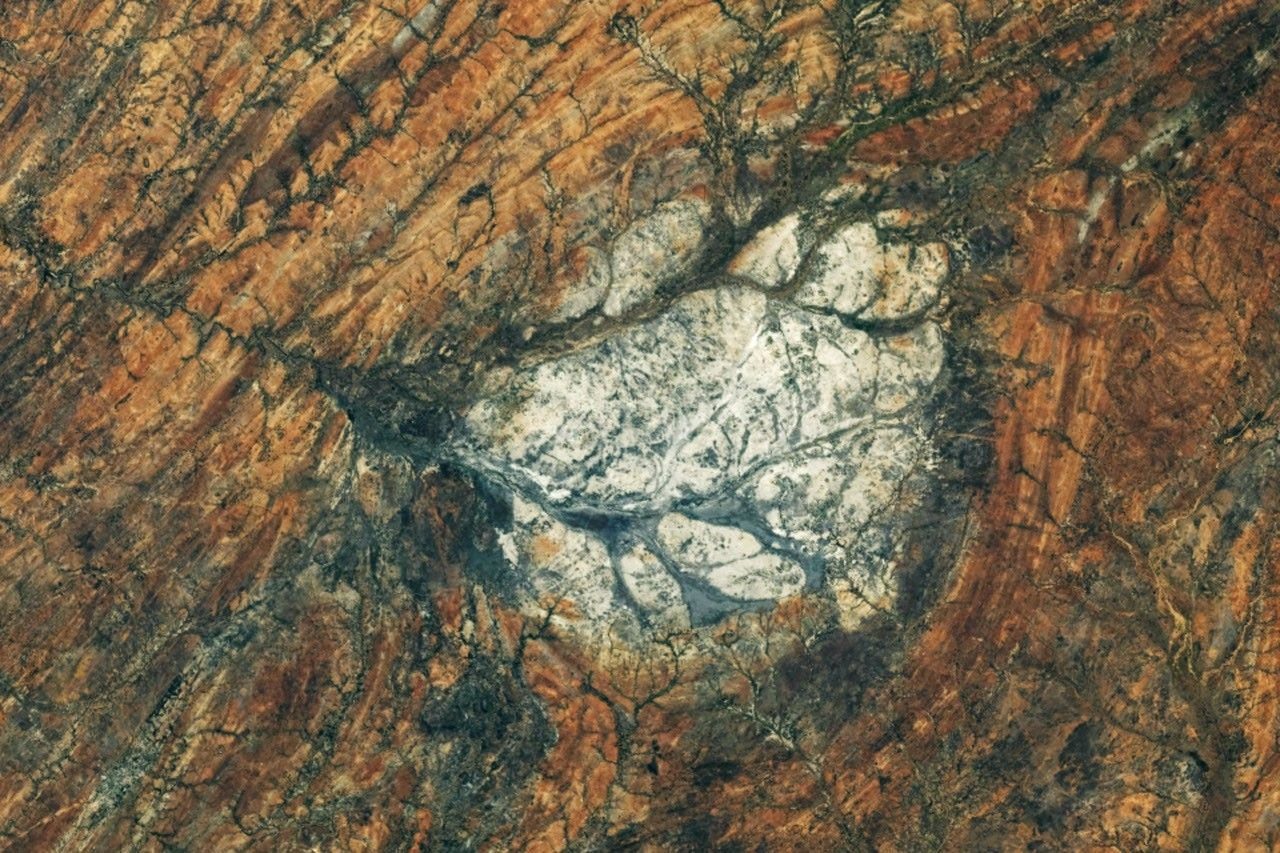
A bright patch of rock in southern Madagascar stands out against the surrounding orange landscape in a photograph released by NASA Earth Observatory on October 5. The circular feature is the Saririaky anorthosite massif, photographed from the International Space Station on August 28. Its striking appearance points to a much older geological story.
Anorthosite is a rock formed when magma cools beneath the surface and large mineral crystals develop. NASA's account places the formation of this Madagascar massif at least 600 million years ago. The exposed rock covers roughly 100 square kilometres, making the feature large enough to be prominent in a view from orbit.
The surrounding landscape carries evidence of intense deformation. Under high temperatures and pressures, rocks were changed and reshaped, leaving long patterns running broadly north to south. Geologists connect this history with collisions between continental pieces during the assembly of Gondwana, the ancient supercontinent that included land now spread across several continents.
The link to the Moon concerns rock type, rather than a claim that the Madagascar feature arrived from space. Anorthosite also makes up much of the Moon's bright highlands. Lunar versions are much older, having crystallised more than four billion years ago during the formation of the Moon's outer crust.
Earth rocks can therefore provide useful comparisons when researchers study lunar materials. Apollo samples are precious and limited, so scientists also investigate suitable terrestrial examples to explore mineral formation and geological processes. A comparison does not make every Earth anorthosite identical to the Moon's; differences in composition and history still matter.
The photograph is a new view of an ancient formation, not evidence that the formation appeared recently. It brings together several scales of time: a 2026 orbital observation, hundreds of millions of years of Madagascar's geology and the even earlier history of the Moon. The visible circle is an invitation to read the landscape carefully.