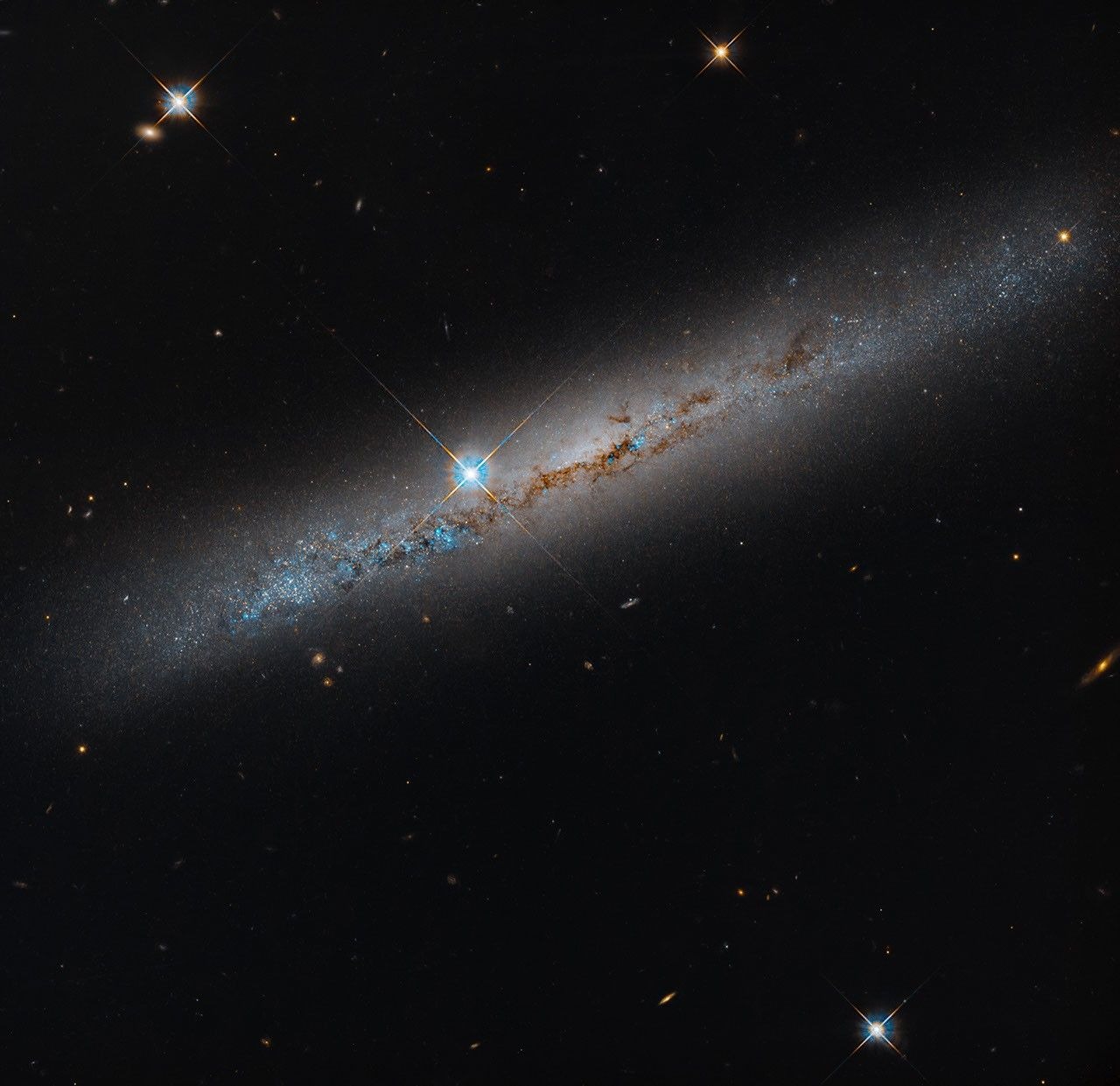
Hubble picture wey NASA release on October 16 show spiral galaxy NGC 1827 almost from the edge. E dey about 37 million light-years away towards Columba. Instead of round spiral with separate arms, the galaxy look like long strip of light for this angle.
Where we dey look from na important part of this picture. We dey look through the galaxy flat disc of stars, so structures overlap differently from how dem go look from above. Dark dust lanes cut through the light, with brighter bulge for the centre.
Bright blue patches along the disc likely show places where stars dey form. But picture alone no be complete count of young stars. Filters wey telescope use, dust for the way and the angle of observation all affect the pattern wey our eyes see.
One very bright object near the central bulge no belong to NGC 1827; na star for foreground. Its four spikes come from how light pass structures wey support Hubble secondary mirror. The real star no get four long shining arms for space.
The observation connect with research on small satellite galaxies around bigger galaxies like our Milky Way. NASA describe programme wey cover 260 satellites around 22 host galaxies. These surveys help scientists compare real small galaxies with predictions from models of how cosmic structures form.
So NGC 1827 give fine portrait and lesson about interpretation together. Two things fit appear close inside photograph without being neighbours for space. Also, viewing angle fit hide galaxy full shape. Instrument details and background information help turn beautiful picture into explanation wey person fit trust.