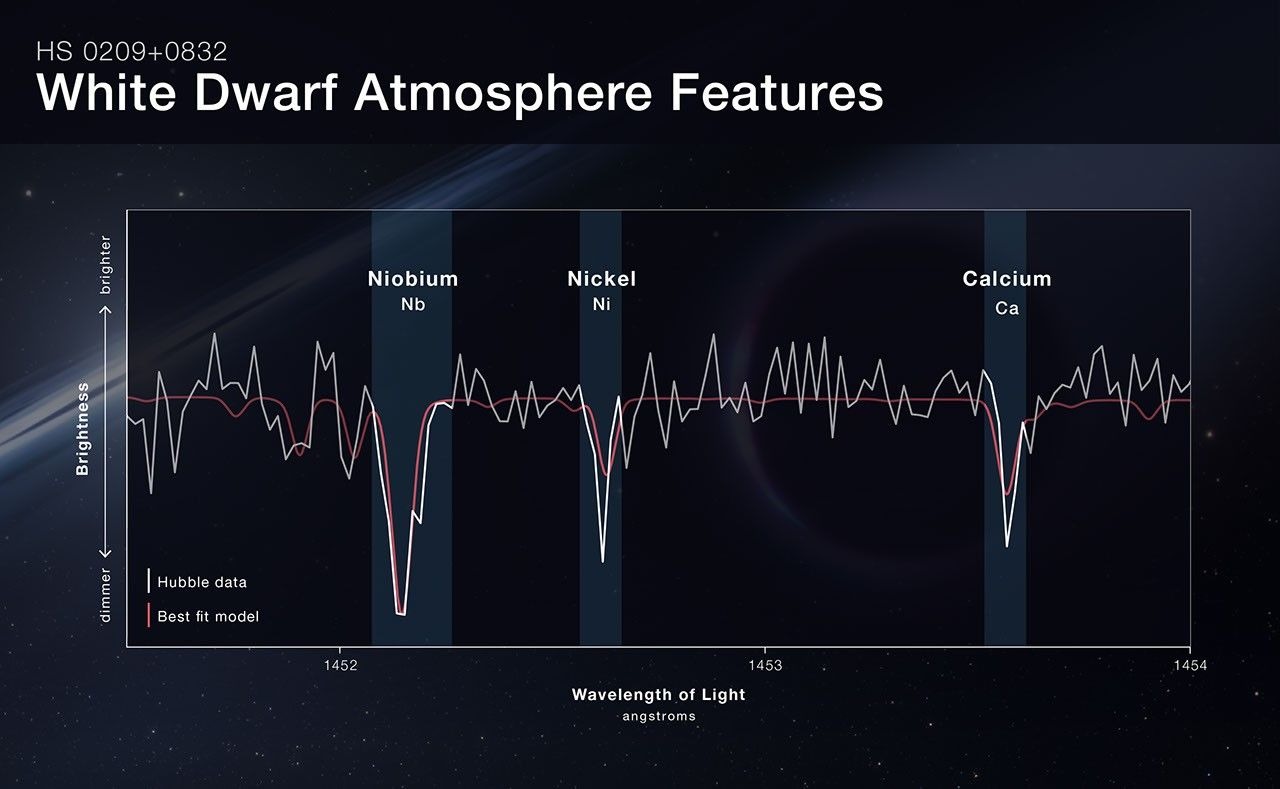
A new examination of old Hubble observations has raised the possibility of a planet formed from material shed by an ageing star. NASA's October 5 account concerns the white dwarf HS 0209+0832. The study proposes an explanation for unusual chemistry, rather than a directly photographed new world.
A white dwarf is the compact remnant left after a low-mass star loses its outer layers. Most familiar planets form alongside young stars. The proposed alternative would form later, using material released during the star's transformation into a remnant.
Researchers revisited spectral features recorded in 1999 using an updated chemical database. Several previously unidentified features matched niobium. They also examined observations from the retired FUSE mission, which supported the presence of that element in the system.
TESS measurements showed periodic brightness variations consistent with a closely orbiting object. The team suggests a gas giant could be losing material into its surroundings, helping explain why unusual elements appear in observations of the star. This remains an interpretation of several lines of evidence.
The proposed formation history is especially interesting because it would give planetary systems another possible beginning. However, a plausible model is not the same as measuring every part of that history. Questions remain about the candidate, its origins and the prevalence of similar systems.
Further observations will test those questions. The study also demonstrates the continuing value of archives: observations that once contained unexplained features can become more informative when researchers acquire better reference data. The candidate planet remains a hypothesis supported by measurements, with its detailed history still to be tested.