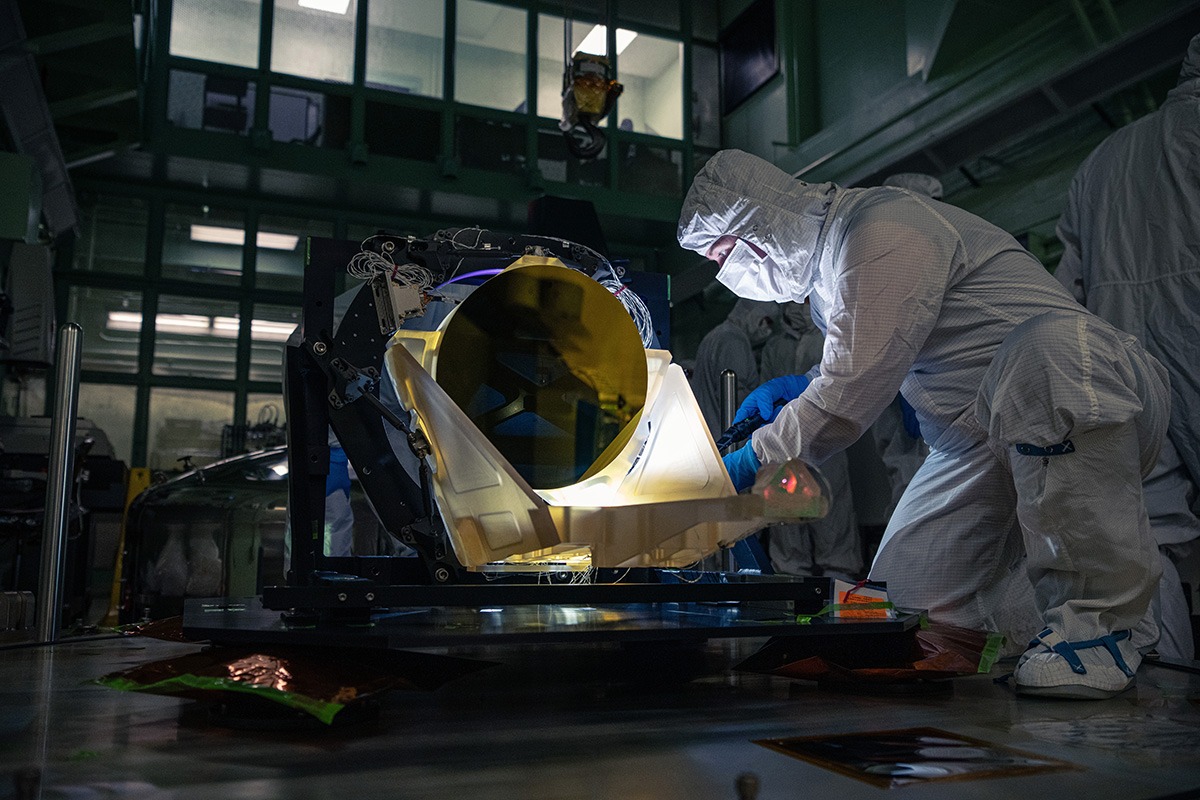
NASA is advancing a new engineering test telescope for LISA, the planned European-led gravitational-wave observatory. Its October 8 announcement describes the next development unit, building on a prototype delivered in 2024. LISA remains a future mission, with launch planned for the mid-2030s.
The observatory would use three spacecraft arranged in a vast triangle. Laser signals between them would measure extremely small changes in separation. Those changing distances can reveal gravitational waves, disturbances associated with moving massive objects, including pairs of black holes.
Each spacecraft needs telescopes that both send and receive laser light. The proposed instruments use a glass-ceramic material chosen for its resistance to changes in shape as temperature varies. Stability matters because unwanted movement can interfere with a very delicate measurement.
The new unit brings lessons from prototype testing into a more advanced design. NASA says it will be the final pre-flight unit and an optical telescope delivery to ESA. That is an engineering milestone, distinct from completing all the hardware needed for the mission.
LISA is intended to study gravitational-wave signals at lower frequencies than ground-based observatories can readily measure. It would complement those facilities, opening another range of events and systems to investigation. The telescope work supports that aim without being a detection result itself.
The story is therefore about turning a measurement concept into reliable equipment. Testing must establish how the optics behave before flight instruments are produced. The photograph shows that preparation on Earth, where engineers can inspect components and address problems while they remain accessible.