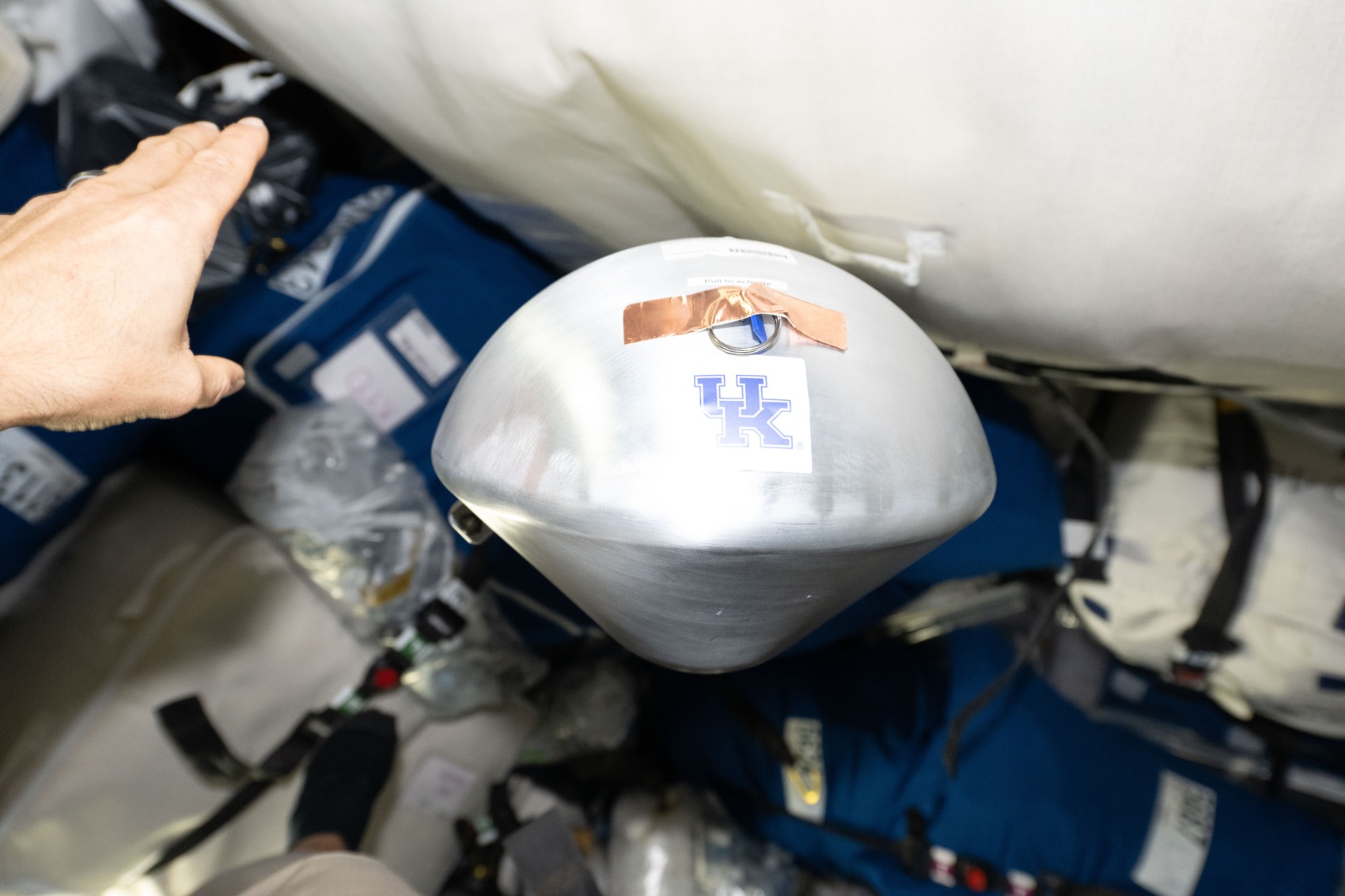
NASA's October 9 account of KREPE-3 describes a plan to use a departing cargo spacecraft as a ride for twelve small atmospheric-entry experiments. The capsules were carried aboard Cygnus XL-24, whose eventual disposal provides a demanding environment for testing heat-shield concepts.
As the cargo vehicle breaks apart during its planned reentry, the capsules are designed to separate and collect measurements. Their instruments record quantities including temperature, pressure and motion, then transmit data through a satellite network. Recovering useful information is the objective, rather than retrieving intact laboratory samples.
Different capsules carry different protection systems. One material, MERINO, uses a carbon-phenolic structure based on stitched felt. Another shield uses a three-dimensional printing approach developed through work involving NASA's Johnson Space Center and Oak Ridge National Laboratory.
The experiment also examines shape and stability. Designs include a dual-cone capsule with a tungsten tip and a shape related to the Dragonfly aeroshell. These configurations help investigate how a small vehicle behaves in the rapidly changing conditions of atmospheric descent.
Another approach, ADEPT, deploys an umbrella-like structure to increase the surface available for slowing a vehicle. Placing several concepts on one flight can supply comparative evidence, but differences in design and trajectory still matter when researchers interpret the measurements.
The October source describes the experiment's intended operation; it does not provide a final performance report for all twelve capsules. The distinction is essential. KREPE-3 is a technology investigation whose value depends on the telemetry actually obtained and the analysis that follows the descent.