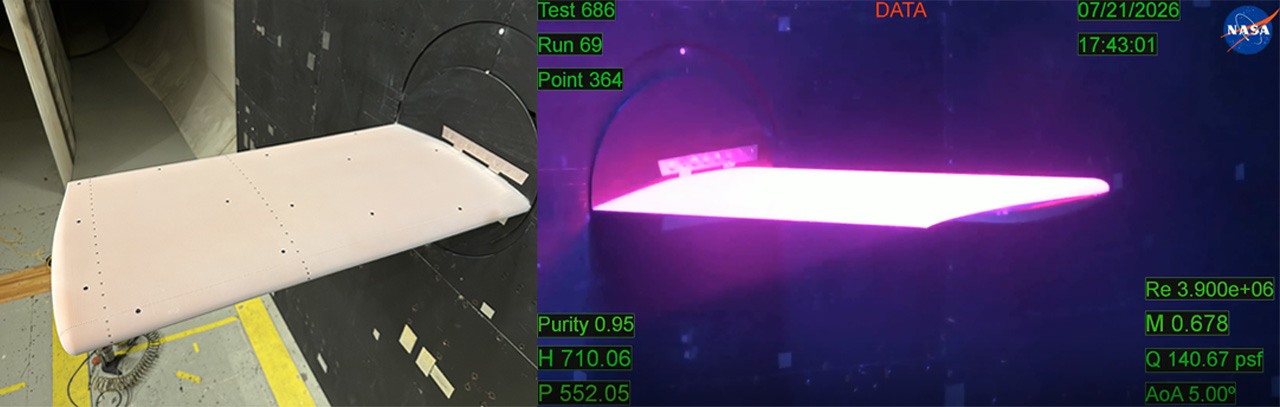
A model aircraft wing glowing pink-purple has helped NASA researchers see how airflow changes across its surface. An October 2 report describes a pressure-sensitive-paint test inside Langley Research Center's Transonic Dynamics Tunnel. The colourful image records an experiment, rather than a new passenger aircraft design.
The coating changes brightness as air pressure changes. Special ultraviolet lights illuminate the wing, while high-speed cameras record the response. Researchers can use those changing patterns to investigate pressure over the surface, gaining information that is difficult to represent with a few isolated measurement points.
The wing is a standard research model called the Benchmark Supercritical Wing. It does not represent a particular airliner. Using a well-understood reference shape helps researchers compare experiments and improve the computer models used to predict how real aircraft behave.
NASA describes this test as the technique's first application to a large, freely moving model in a low-oxygen environment. That combination matters because a moving structure and changing airflow affect each other. Measuring only a rigid, stationary model does not answer every question about a flexible aircraft.
The work could support future tests of wings designed to bend during flight. Such designs require engineers to understand motion and pressure together, rather than treating the wing's shape as fixed. The experiment provides a measurement capability; it does not prove that a particular future aircraft will achieve a promised efficiency.
The vivid colour therefore has a practical purpose. It makes a normally invisible physical quantity easier to study and compare with calculations. The next value will come from repeatable measurements and better predictions, with the glowing photograph serving as a view into that research process.