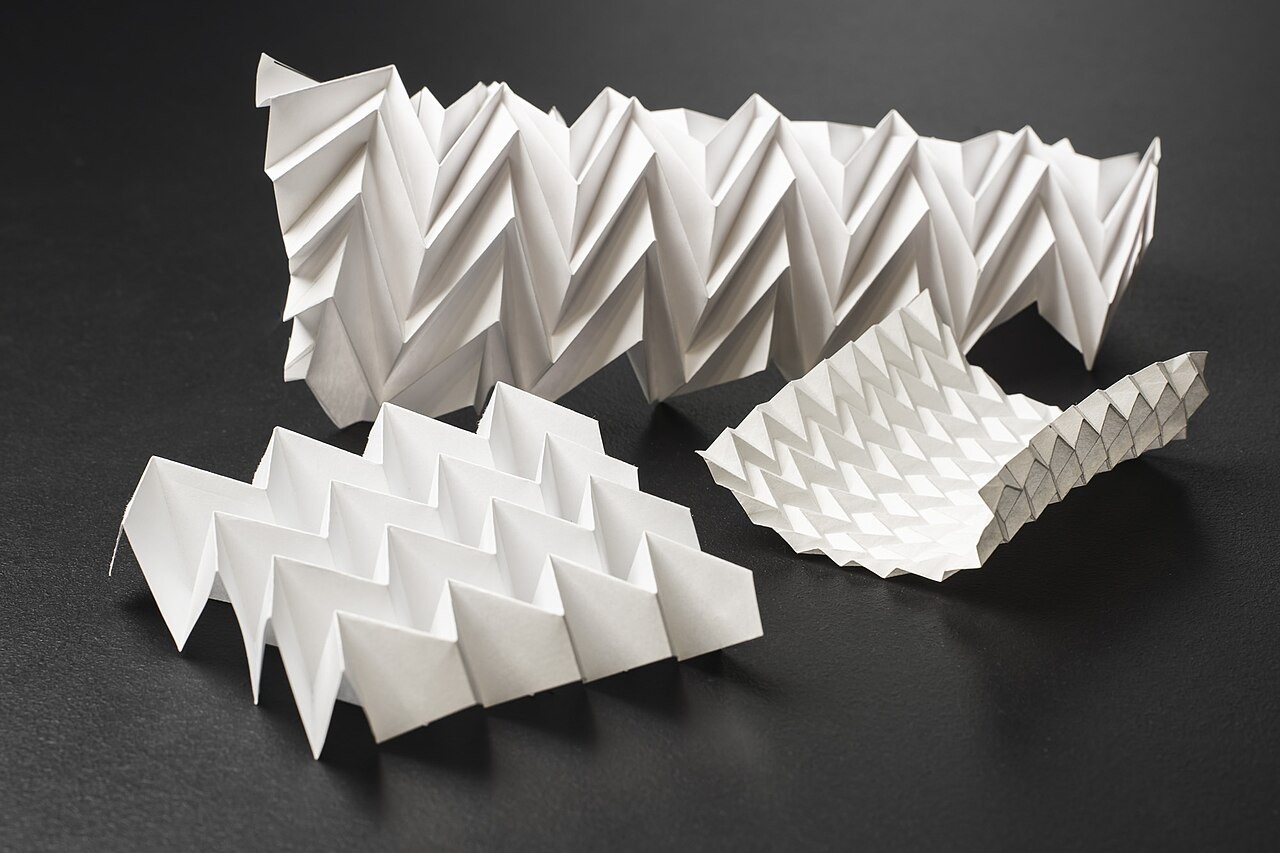
An origami-inspired construction method reported by MIT on October 27 uses separately folded metal pieces to make large, rigid structures. Researchers demonstrated the approach with a suspended sculpture at Boston Public Library, bringing a laboratory idea into a public architectural setting.
The starting point is a flat sheet. Individual units are cut, folded and connected into a lattice. Their geometry locks the assembled structure into place. This differs from treating an entire building shape as one enormous sheet that must be folded together.
A computer tool divides the design problem into smaller cells and checks whether each can be manufactured and folded. That makes computation part of the assembly process, rather than only a way to draw an attractive shape before someone works out how to construct it.
The team reported simulations showing greater stiffness with less material than some competing origami approaches. Those comparisons concern particular methods and conditions; they are not a claim that folded metal outperforms every conventional building material or structure.
The library installation provided a practical demonstration, assembled with hand tools. Proposed future uses include rapidly assembled shelters and lightweight components. A demonstration sculpture, however, does not establish the weather resistance, service life or suitability of a completed emergency shelter.
The unusual contribution is the connection between foldable parts and a rigid final form. Further architectural testing can examine how that connection behaves at larger scales. For now, the work shows how carefully designed joints and repeated units can turn a familiar paper-folding principle into a construction experiment.