An October 14 NASA report describes a likely explanation for an unusual radio-emitting structure known as the Treble Clef. Researchers connect its shape and brightness to an old black-hole outburst followed by a collision between two clusters of galaxies.
The object is difficult to study because it lies almost behind the plane of our own Milky Way. Foreground stars, gas and dust obstruct ordinary views. X-ray, radio and infrared observations provide complementary information that helps researchers distinguish the distant structure from intervening material.
Chandra and eROSITA detected diffuse hot gas, establishing that a galaxy cluster surrounds the radio source. Further examination indicated two clusters in a merger. These are enormous systems containing galaxies and extensive reservoirs of gas, so the encounter affects much more than individual stars.
The proposed sequence begins when a supermassive black hole drove out charged particles and magnetic fields. Their radio emission faded as the particles lost energy. The later cluster collision could compress or reenergise that material, making it bright again; shock waves may contribute.
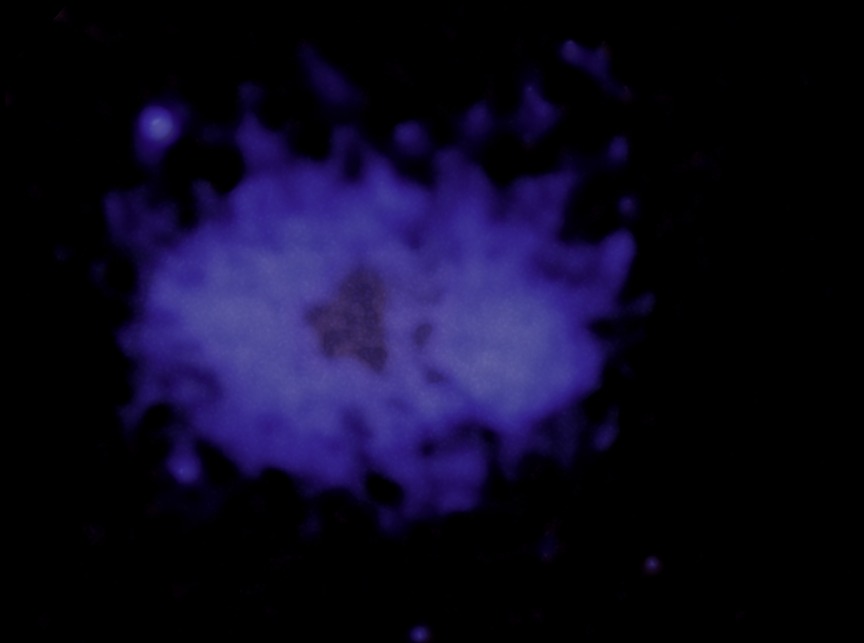
Researchers also removed an approximately symmetrical oval component from the X-ray data. The remaining emission is brighter to the left and right than at the centre, supporting an inferred collision direction. They estimate the direct encounter happened a few hundred million years ago.
The name describes a resemblance to musical notation, not evidence that the cluster makes written music. The scientific claim rests on gas structure and radiation measurements. Its strength is the combination of observations, while the detailed physical sequence remains an interpretation of those observations.