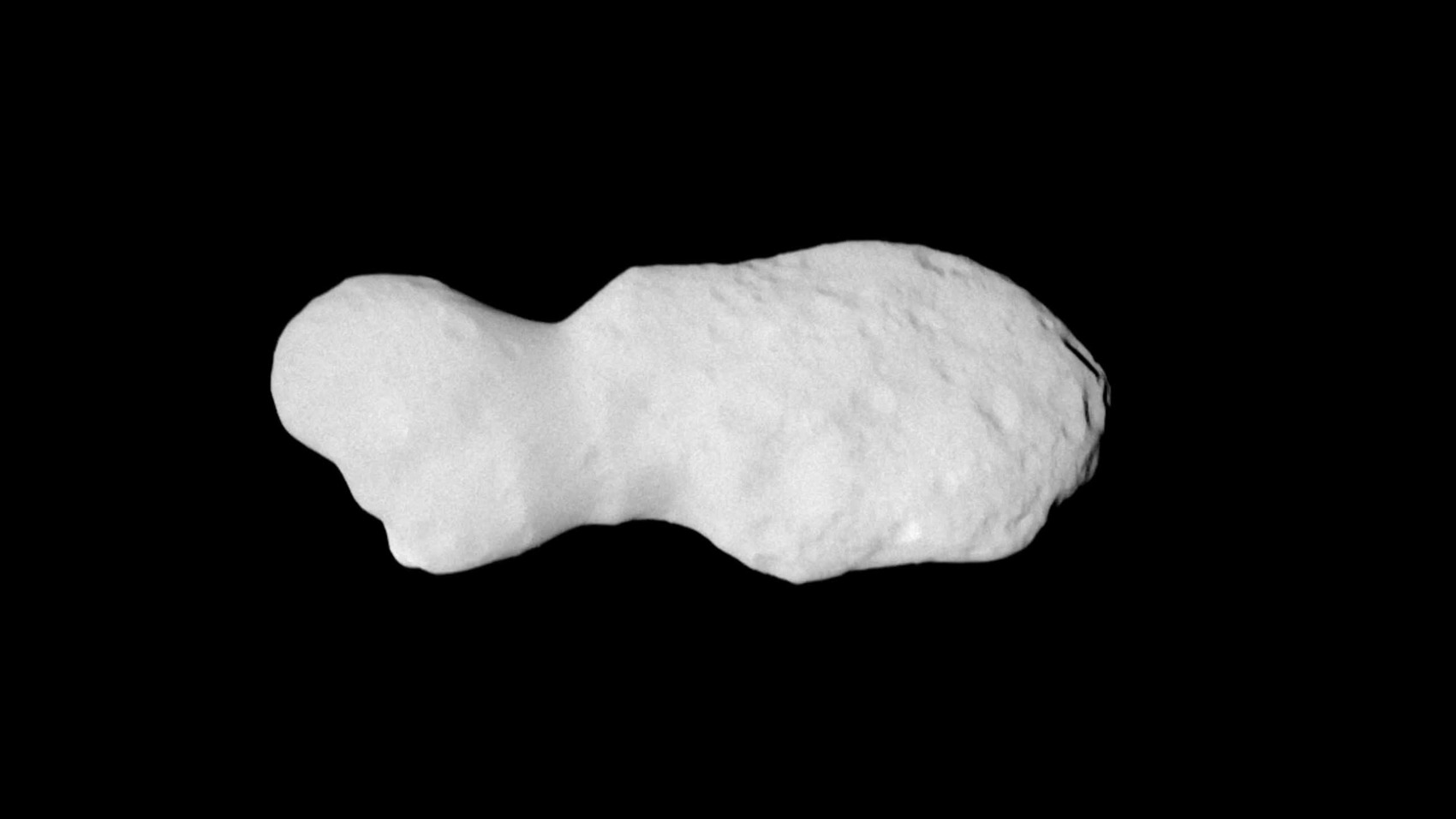
NASA's June 18 account of Lucy's encounter with Donaldjohanson describes an asteroid with a surprisingly complicated history. The spacecraft passed about 1,000 kilometres away on April 20, 2025, collecting close-up images and other measurements during a rehearsal for its later Trojan asteroid encounters.
Donaldjohanson consists of two lobes joined by a narrow neck. Researchers interpret this peanut shape as the outcome of fragments gently joining after an earlier collision. Its current structure is therefore evidence about assembly, rather than simply an amusing resemblance to a familiar food.
The rotation also proved more complex than ground-based observations suggested. The analysis gives an end-over-end rotation of about 10.5 Earth days, accompanied by a wobble around its long axis lasting about 26.5 days. It does not spin steadily around just one simple axis.
Researchers propose that solar heating helped slow its rotation over millions of years. Unevenly emitted infrared radiation creates a tiny twisting force, known as the YORP effect. As rotation changed, loose material could move down slopes, helping explain softened or worn-looking crater shapes.
Lucy also detected signatures of iron-rich clay minerals. Those minerals point to water acting in the distant past, but the scientists infer relatively brief exposure compared with the histories recorded at Bennu and Ryugu. The evidence does not imply liquid water currently flows across Donaldjohanson.
The June findings turn a planned practice flyby into a useful comparison between asteroids. Shape, spin and minerals preserve different aspects of their history. Reading them together helps researchers test how objects formed, changed and moved long before a spacecraft arrived to inspect them.